Tuesday, November 27, 2007

Troy Hill Firehouse


Image from Troy Hill Citizen's Council

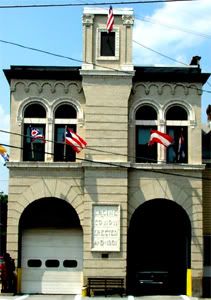
Engine House #39 was built in 1901 and dates back to the days of old Allegheny City. The firefighters stationed there served the residents of Troy Hill and their homes, nestled among the slopes and twisting roads of North Side.

It was the last station to use horse-drawn fire carriages and the only one left with an old time fire bell, named Die Glocke Sarah. It even sported a pole for firemen to shimmy down to reach their engines. It was named a historic structure by the Pittsburgh History & Landmarks Foundation in 2001.

But no one told fire captain Don Dorsey that the building was haunted when he took command. He found out the hard way. Blankets were pulled off sleeping firefighters. Window shades went up and down for no reason. The dorm trap door closed on its' own. Footsteps were heard upstairs and on the stairway. Closed doors creaked open. Whenever the firemen went to check on the phenomena, they found nothing.

Spectral firefighters have been briefly spotted sitting around a table playing cards in the basement, whiling away the hours as they did in life. The only identifiable spirit is that of Queenie, an old firehouse dog that still enjoys jumping up and down on a second floor bed.

A psychic that visited the engine house told the firemen not to worry. The spirits – 8 firefighters, 3 chaplains, and Queenie by his count - were there to protect the flesh and blood crew of firefighters and even went out on calls with them.

The station was closed in a round of city budget cuts in 2005. But after all these years, it's a pretty safe bet that the phantom firefighters of Engine House #39 are still on call in Troy Hill. This is another four alarm tale told in Ghost Stories of Pittsburgh and Allegheny County by Beth Trapani & Charles Adams III.

Thursday, November 22, 2007

Phillip's Rangers

Photo Sharing and Video Hosting at Photobucket

Image from Mother Bedford

This is a bit of lore from Bedford County from back in the day when we were the wild frontier. Captain William Phillips and a small band of militia numbering a dozen in all were sent to Bedford County to quell an Indian uprising.

They marched on July 15, 1780, over Tussey Mountain and into into Woodcock Valley, finding nothing but deserted cabins. The settlers had already fled for safer ground. They chose one of the empty cabins to stay in overnight. Imagine their shock when they discovered in the morning that they were surrounded by a large band of warriors.

They didn't seem to know the Rangers were there at first, but eventually a shot rang out and the battle was joined. It was a fight the Rangers couldn't win, and Phillips went out to surrender after the cabin was set ablaze by flaming arrows. The deal was that they would lay down their arms if their lives were spared. But the Indians welshed on the bargain.

They separated Phillips and his son – they would be worth something in a trade – and a small party took them away. They eventually ended up as British POWs for the next two years. The Rangers, though, were tied to trees, cut open and tortured, and finally put to rest with arrows. It was a slow and savage way to die. A relief column led by Colonel John Piper cut the bodies down and buried them at the spot.

While building a monument in the 1930s for the men at the site of the massacre, 9 of the 10 bodies were found and interred in a common grave that was incorporated into the parklet dedicated to their memory.

It's said that they relive the anniversary of the slaughter, and the Rangers and Indians show up every year late at night on July 16 to continue their battle. There's also supposed to be a solitary black shadow that watches over the grave whose presence can be felt and sometimes seen. Is it Phillips? Is it the Ranger whose body they didn't find? No one knows for sure.

Sunday, November 18, 2007

The Most Haunted House In America...Not

Photobucket

image by Daniele Montella

Renowned as the “Most Haunted House in America”, the alleged history of the Congelier House is enough to turn anyone's blood cold.

The story goes that 1129 Ridge Avenue was home to Charles & Lydia Congelier, who built the house in the 1860's, and their maid, Essie. The tale begins in 1871. That's when Lydia found out Charles was having an affair with the maid, and ended it by stabbing Charles to death, beheading Essie, and driving herself insane.

The house sat vacant for the next two decades. It was remodeled to become a dorm for railroad workers in 1892, but they wouldn't stay in the house, claiming to hear the sobbing and screaming of a woman. Then it gets interesting.

Around the turn of the century, Dr. Adolph Brunrichter moved in. His maids didn't end up lovers, but cadavers. He beheaded them and then did experiments to keep the heads alive, which apparently he could do for short periods of time.

On August 12, 1901, the neighbors heard a scream and saw a red flash come from the house, blowing out all the windows. The good doctor vamoosed, and police found a decomposed body strapped to a bed and five headless corpses buried in the basement.

Needless to say, the house again remained unoccupied for awhile. Equitable Gas later fixed it up to use as a dorm for its' Italian workforce. They experienced many odd happenings, but wrote them off to hooliganism from the American workers they had displaced, at a lower wage. Then one night two of them were found in the basement, one with a board impaled through him and the other hanging from a joist.

Local police claimed it was an accident – one man fell going down the steps and speared himself on a propped up board, and the other strangled himself in the dark cellar on some loose wiring.

Naturally enough, the house was empty again. In 1920, Thomas Edison allegedly visited the home. He was interested in building a machine to communicate with the dead. The results aren't recorded, but its' said that he left the house as a great believer in the afterlife.

In 1927, police arrested a drunk who claimed to be Dr. Brunrichter. He regaled them with tales of orgies, demonic possession, torture and murder, and wrote “What Satan hath wrought let man beware” in his own blood on the wall of his psychiatric ward. The media called him the “Pittsburgh Spookman”, but officials couldn't figure out if was indeed the doctor or just an imaginative alcoholic, so they let him go, never to be seen again.

That same year, a huge gas tank was being built near the current site of the Carnegie Science Center. It blew, and the ensuing explosion rocked buildings within a 20 mile radius. The Congelier House disappeared from the face of the earth, leaving nothing behind but an 85 foot deep crater. People said Satan himself pulled the ill fated house into the depths of hell.

It's also been said that on occasion a spectral house appears on the site, shimmering and then disappearing again to the netherworld. This was all documented in Richard Winer & Nancy Osborne's book Haunted Houses.

Alas, like most good stories, this one has its' debunker, too. Troy Taylor rebutted the Congelier House claim to evil immortality in his article Dead Men Do Tell Tales: The House On Ridge Avenue, found on the Prairieghosts site.

First, he can find no record of a Charles Congelier living in Pittsburgh or of Lydia's murderous ways, which one would expect to fill the local rags of the era. Next, he says the modest rowhouse was built in the 1880's, totally screwing up the original timeline.

Marie Congelier owned & lived in the house (at least the family name was right), and no trace of the evil Dr. Brunrichter has ever turned up, either as a tenant or a mad scientist. Ditto for the railroaders. They never roomed at the Congelier house.

Marie says that Edison never visited her humble home, and one would assume she'd remember if the Wizard of Menlo Park came calling. He also found that no reports of any deaths, accidental or otherwise, existed from the Ridge Street address. He couldn't find any mention of the “Pittsburgh Spookman” in the papers.

Finally, the gas explosion didn't send the house straight to hell, but only shattered a few windows. The house was eventually razed to make room for a highway interchange. Marie, by the way, died the morning of the gas explosion, not from the blast, but from an accidental cut. She bled to death en route to the hospital, the only known death recorded of someone from the Congelier House. Thanks for ruining a nice spooky tale, Troy.

Wednesday, November 14, 2007

Gudgeonville Bridge Legend


(image from Erie Yesterday)

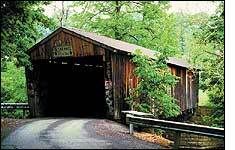
The Gudgeonville Covered Bridge doesn't look like much now, lopsided, vandalized, and covered in graffiti. But it's got a grand history behind it. It was built across Elk Creek in 1868, supposedly on the foundations of the old Erie Extension Canal. After a fire, it was rebuilt in the 1870s, and still stands just south of Girard.

There are several tales connected to the bridge. One, dating back to 1900, says that you can sometimes hear the sound of thundering hooves approaching and then crossing the planks of the bridge. A black stallion with fiery red eyes appears speeding a horseman across the span. Hopefully the steed knows where it's going – its' rider is headless!

Another story involves a young girl that fell to her death sometime in the 1940s or 50s while playing on the white shale cliffs (known locally as the Devil's Backbone) nearby the bridge. She's alleged to walk the bridge on moonless nights and the anniversary of her death. Sometimes you can watch her reliving the plunge to her fate from the cliffs.

But the Gudgeonville legend is based on a poor mule that wouldn't cross the bridge. In the mid 1800s, a man named Obadiah Will of Kentucky was delivering a mule to a man in Meadville. As he was crossing the bridge, a couple of barges carrying Dan Rice's Circus from Girard were floating down the creek, a calliope tooting away on one of them. At this point, different versions pop up.

One says that when the music reached the mule's ears, it literally frightened the creature to death. It dropped dead of a heart attack right where it stood. The mule's name was Gudgeon.

In another twist on the tale, the mule froze when it heard the music and in true jackass style, it refused to budge off of the bridge. In frustration, Will either found a hefty stick and beat Gudgeon to death, or grabbed a wagon part known as a gudgeon and hit the nameless mule with the same end result. (Some spoilsports think the name came about because the small fish in the creek were locally known as gudgeons, but we'll ignore them.) In a final bit of irony, the calliope was supposed to be playing “My Old Kentucky Home.”

Anyway, the mule was buried on the west bank of the creek, and Will had “Gudgeonville” (which doesn't exist as a town) painted on both entrances to the bridge in remembrance of the frightened mule that wouldn't cross the dang bridge. He also sued the circus with unknown results. Apparently Dan Rice, the circus owner and a fairly famous entertainer of the era, felt badly enough to write up the tale in the form of an eulogy. (We ran across several references to it, but can't find the eulogy itself.)

The mule's spirit never did leave the bridge. It's said you can still hear its' steady hoofbeat and braying on some nights.

Saturday, November 10, 2007

The Spirits of the Railroaders Memorial Museum


image from the Railroaders Memorial Museum

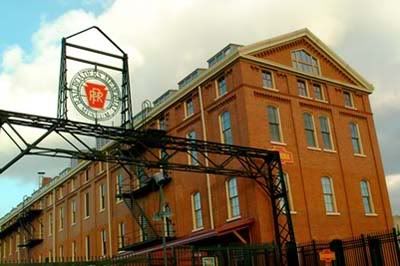
In 1882, the Pennsylvania RR built the Master Mechanics Building in Altoona to use as an office. It later became an infirmary and HQ for the railroad police, and today it's the Railroader's Museum.

Hauntings and weird events are an everyday happening there. In the guest shop, toys and models will be taken from their shelves and left in neat stacks on the floor. Frank the spook is often seen clambering on the train engine that sits in the lobby by the entrance to the museum. Frank's picture is hung in the hall – from the 1920s, when he was a flesh and blood member of the train crew. He's also been seen roaming the lobby and spotted in the elevator.

Big band music can be heard on the second floor coming from Kelly's Bar, where the old railroaders would stop after their shift and wash down the track dust with a cold brew or three.

One museum staffer rips the filters off of his cigarettes and leaves them for the spooks whenever he visits there (they smoked unfiltered Camels back in the day.) When he returns, the cigarettes are either moved or gone, and the smell of tobacco smoke fills the room, even though it's now a strictly no-smoking building. They really should break that habit. Maybe the staff should leave them nicotine patches instead of butts.

A spirit by the name of “Big Boss” hangs out on the fourth floor. Two men in flannel shirts have been seen walking the halls, looking disorientated. The building's new layout must have them confused. Orbs have been photographed many times throughout the museum. Old railroaders must have a hard time giving up the ghost - and the good times at Kelly's Bar.